“It is difficult to talk about the 2016 vintage, for purely emotional reasons…but we believe that it can certainly be considered a historical year”
Precipitation and temperatures
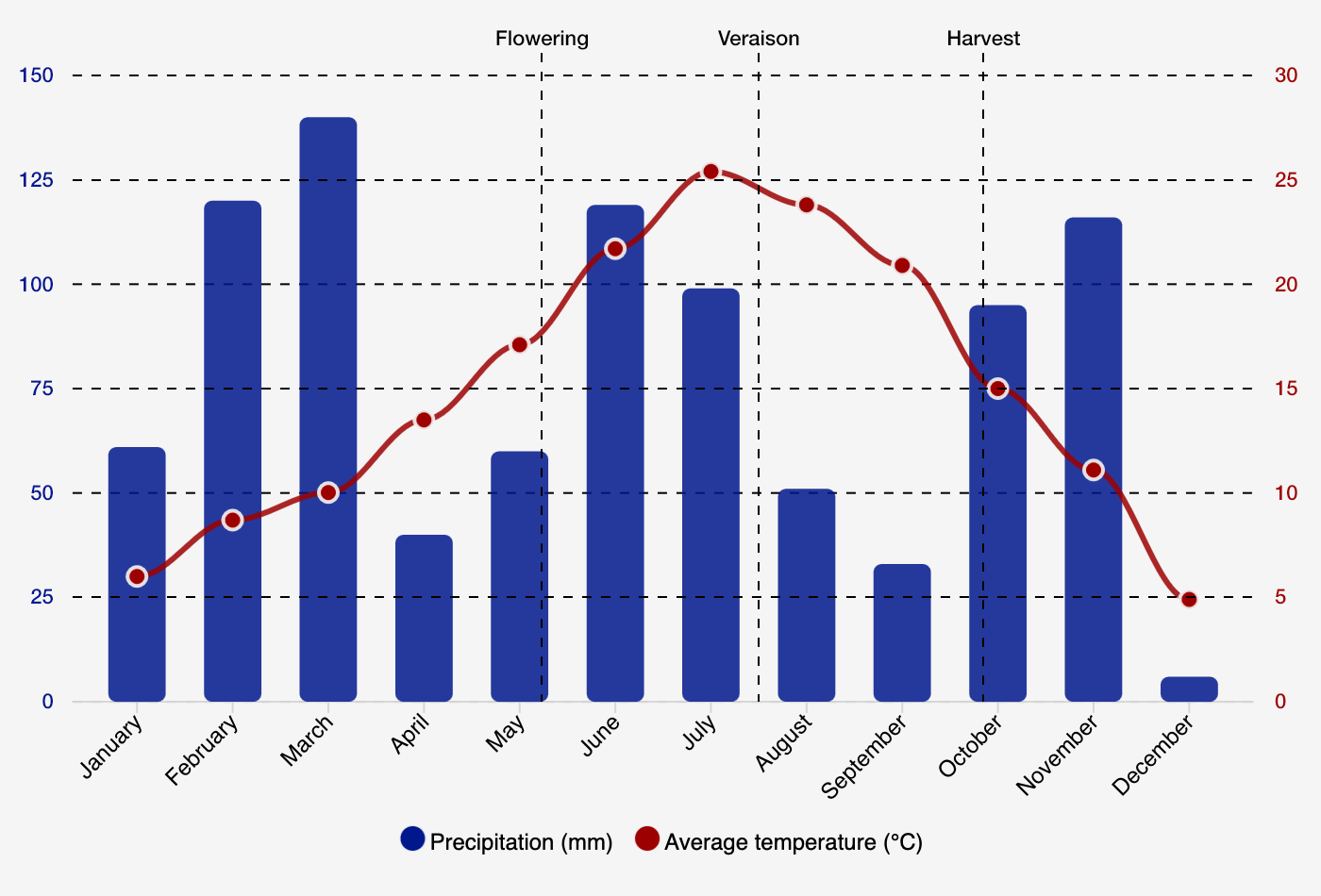
2016 vintage showed greater rainfall than the average, with about 10% more than in previous years. It was the fourth consecutive year with higher rainfall than normal, an aspect that in any case is not at all in contrast with the increase in temperatures.
WINTER – This season was practically absent, the third warmest since 1950. It was a rainy winter, + 40% compared to the norm. The month of February was very rainy, with heavy rainfall.
SPRING – Atypical and warm. April was particularly warm while in general the spring rains were above normal values thanks to the months of March and May.
SUMMER – Warm, but not hot. The summer rains were scarce. June showed slightly higher rainfall while July and August were below average.
Precipitation and temperature graph + flowering, veraison, harvest
Precipitation and temperature
2016 vintage showed greater rainfall than the average, with about 10% more than in previous years. It was the fourth consecutive year with higher rainfall than normal, an aspect that in any case is not at all in contrast with the increase in temperatures.
WINTER – This season was practically absent, the third warmest since 1950. It was a rainy winter, + 40% compared to the norm. The month of February was very rainy, with heavy rainfall.
SPRING – Atypical and warm. April was particularly warm while in general the spring rains were above normal values thanks to the months of March and May.
SUMMER – Warm, but not hot. The summer rains were scarce. June showed slightly higher rainfall while July and August were below average.
Maturation
The path of phenological development and grape ripening was generally well balanced, despite the rains and high temperatures, especially in the first part of the year.
The most well-drained clayey soils collected and retained without asphyxiation and released at the right time. A gravellier terrain has supported the vine well in the first part of the season and above all enjoyed an excellent second part proving to take advantage also of high temperatures.
The flowering to ripening stage was characterized by abundant rainfall and temperature higher than average, while in the ripening to harvest stage we had normal rains and less hot temperatures.
Thanks to balanced vegetative development and widespread health, only regular interventions were made.
Harvest
The harvest took place between September 23rd and October 5th in line with the vintage.
First Ancellotta, second Merlot, then Sangiovese “Costa Alta” followed by a brief interruption due to rain. Work continued September 30th starting from Sangiovese “Lazzara” located by the homonym stream.
The harvest ended on October 5th with the Cabernet Sauvignon “Storico” placed in the highest area of the vineyard.
Cellar
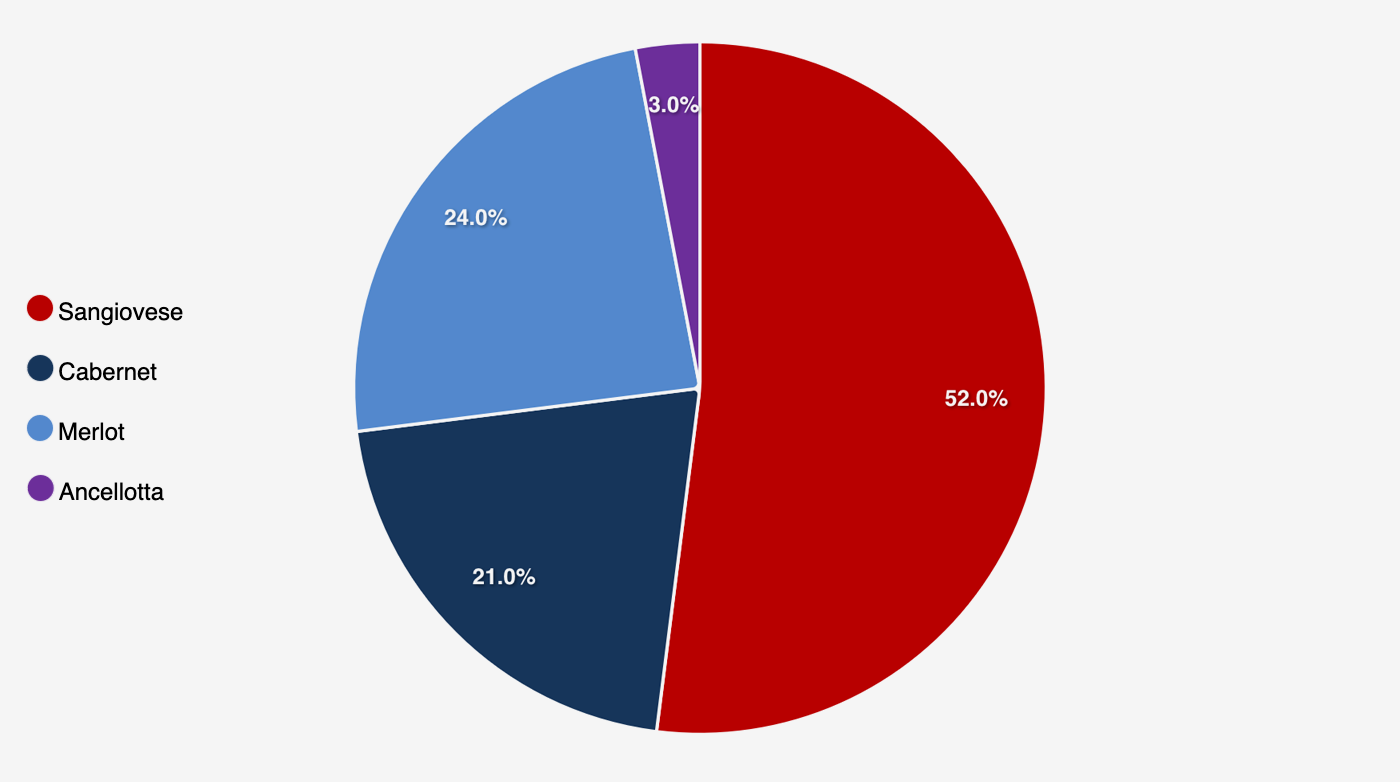
Sangiovese, shaped by five distinct growing areas, expresses bold structure and vibrant acidity, and is harmoniously married to Ancellotta, with its well-developed, warm character.
Since the alcoholic fermentation, a flawless Cabernet Sauvignon “Storico” has proved its peculiarities, each well defined.
The pace of this vintage is led by Merlot, very well balanced in the fermentation phase and always constant in its maturation. It gives full expression of the habitat in which it grows due to the gravelly soil and the proximity to the bed of the Marecchia river.
Fermentation phases were regular and lasted from 22 to 27 days. PH and malic acid were in equilibrium.
Cabernet was the first to begin malolactic fermentation which all 4 wines achieved before December.
Cement tanks passage of about 3/6 months.
Aging in wood of 22/24 months.
Refinement in bottle of at least 18 months.
A solid product even from the microbiological point of view without clarification nor filtration.
9.000 bottles produced
Blend